
As August draws to a close, health and social care managers across the UK are turning their attention to autumn and winter planning.
For community services, this often means preparing for increased demand, greater pressure on discharge pathways and more people requiring timely support to remain safe and independent at home.
Against this background, the ability of frontline teams to make safe, proportionate and defensible decisions about simple equipment and home adaptations becomes increasingly important.
For Local Authorities, NHS teams, housing providers and community services, Trusted Assessor Training can help build the workforce capacity needed to respond efficiently to straightforward cases while ensuring more complex situations are recognised and referred appropriately.
The aim is not to replace Occupational Therapists.
It is to enable appropriately trained staff to manage simple pieces of equipment in straightforward cases safely and confidently, while protecting specialist Occupational Therapy capacity for complex, high risk and clinically demanding work.
Why autumn planning matters for equipment and adaptations
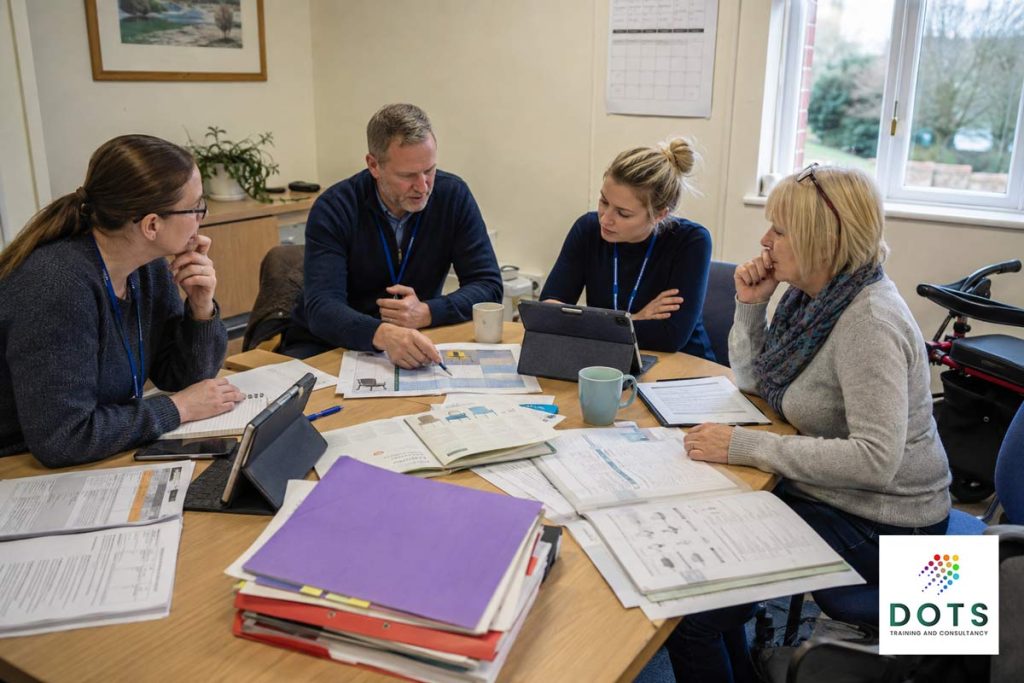
Autumn and winter planning is often discussed in terms of hospital discharge, urgent care and social care capacity.
However, equipment and adaptations form an important part of the same pathway.
A timely grab rail, bathing aid, mobility solution or minor adaptation may enable somebody to continue managing safely at home. Resolving a straightforward need early can help prevent a relatively small difficulty from escalating into a larger problem.
The challenge is making sure equipment is not simply provided because it appears to be the obvious answer.
Frontline staff need to understand:
- what the person is actually finding difficult
- how their functional ability affects the task
- how the home environment contributes to the problem
- whether the proposed equipment is appropriate
- whether the decision sits within their scope of practice
- when further assessment or specialist input is required
When these decisions are made well, services can respond more efficiently while maintaining safe and consistent practice.
What do we mean by a defensible decision?
A defensible decision is not necessarily a risk-free decision.
People live in real homes and make their own choices. Their environments, routines, health conditions and support networks are different.
The role of an assessor is therefore not to remove every possible risk.
A defensible decision is one where the assessor can demonstrate that they considered the relevant information, understood the risks, stayed within their scope of practice and reached a proportionate conclusion.
In equipment and adaptations practice, this should usually include evidence of:
- the person’s presenting need
- the activity they are finding difficult
- relevant functional observations
- environmental factors
- risks identified
- options considered
- the person’s wishes and preferences
- why the chosen intervention was considered appropriate
- whether the decision remained within the assessor’s role
- any advice, referral or escalation required
Good documentation allows another professional, manager or auditor to understand how and why the decision was reached.
Simple equipment still requires good assessment
Trusted Assessor pathways are often designed to enable trained staff to support simple equipment provision in straightforward cases.
That can improve access to services and help people receive appropriate support sooner.
However, “straightforward” should never mean “no assessment required”.
A request for a simple item of equipment may reveal wider issues.
For example, a person asking for a grab rail may also report several recent falls. Someone requesting bathing equipment may have rapidly deteriorating mobility. A request for a stair rail may reveal fluctuating cognition or difficulty following instructions.
This is why Trusted Assessors need more than product knowledge.
They need a clear framework for deciding:
- whether the case is genuinely straightforward
- what risks need to be considered
- what information needs to be recorded
- whether the intervention is proportionate
- whether they should proceed or escalate
Recognising when not to prescribe is as important as knowing when to prescribe.
How trained frontline teams can support service capacity
When non-OT staff are appropriately trained and supported, straightforward equipment and adaptation needs can often be managed without unnecessary referral into specialist pathways.
Depending on local service arrangements, this may include:
- social care assessors
- housing officers
- reablement staff
- therapy assistants
- community equipment staff
- Trusted Technicians
- other frontline workers operating within agreed assessment pathways
This can support services in several ways.
Reducing unnecessary waiting
Where a need is straightforward and sits safely within the assessor’s competence and role, resolving it at the first appropriate point of contact may avoid unnecessary delay.
This matters particularly during periods of increased demand.
Delays with relatively simple needs may contribute to:
- reduced independence
- increasing reliance on carers
- greater difficulty completing everyday activities
- increased risk
- avoidable escalation into more complex services
Trusted Assessor pathways can help ensure the right level of professional resource is used for the right level of need.
Protecting specialist Occupational Therapy capacity
Occupational Therapists bring specialist clinical reasoning that should be available for people who genuinely require it.
Effective Trusted Assessor pathways can allow Occupational Therapists to concentrate their time on areas such as:
- complex functional assessment
- high risk situations
- major housing adaptations
- complex Disabled Facilities Grant cases
- rapidly changing conditions
- complex moving and handling
- rehabilitation
- safeguarding concerns
- complex mental capacity issues
- situations where several risks interact
- cases where straightforward equipment will not adequately address the person’s needs
The purpose of workforce development is therefore not simply to process more cases.
It is to create clearer pathways so that specialist expertise is directed where it adds the greatest value.
The key elements of defensible decision making
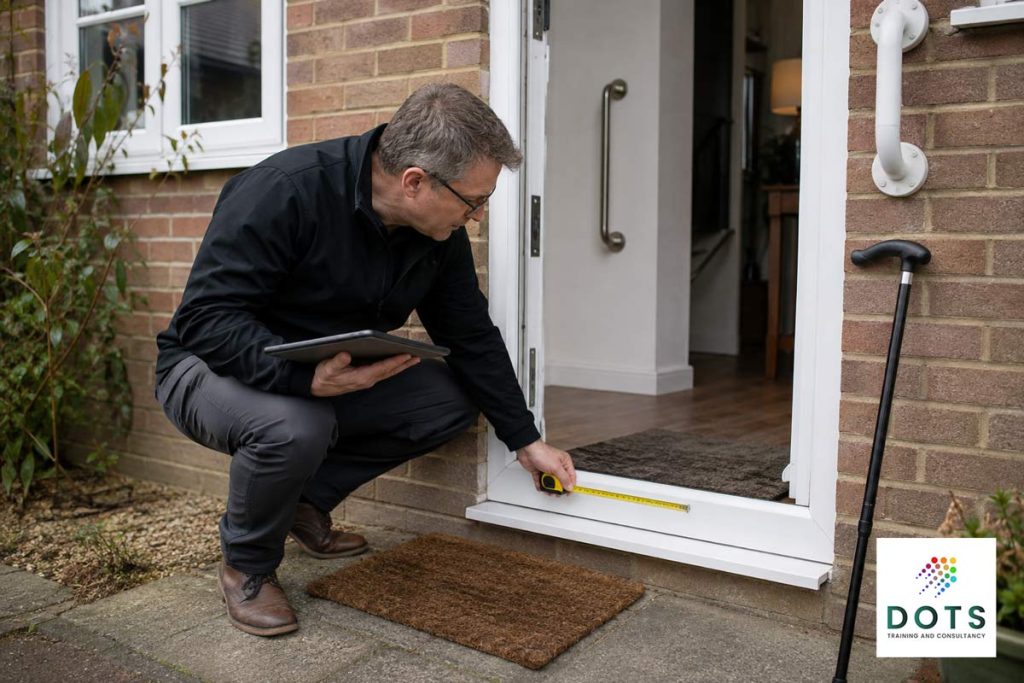
Several areas are particularly important when frontline staff are assessing for equipment and adaptations.
1. Start with function, not equipment
A common risk in equipment provision is beginning with the requested item rather than the person’s functional difficulty.
A referral may say:
“Needs a grab rail.”
But a Trusted Assessor should first understand why.
Questions may include:
- What is the person trying to do?
- What part of the activity is difficult?
- When did the difficulty begin?
- Has their function changed recently?
- What do they currently do to manage?
- What happens when they attempt the activity?
- Is the difficulty caused mainly by the person’s function, the environment or both?
- What outcome does the person want?
The answer may be a grab rail.
But it may also be a different piece of equipment, an environmental change, advice about technique or referral for a more detailed assessment.
Understanding function before prescribing helps avoid inappropriate equipment provision.
2. Consider the whole home environment
Equipment does not exist in isolation.
The same item may be appropriate in one person’s home and unsuitable in another.
Assessors need to consider factors such as:
- available space
- floor surfaces
- steps and thresholds
- furniture position
- access routes
- lighting
- where the person carries out daily activities
- other equipment already in use
- whether carers need access
- whether the proposed equipment could create a new obstruction or hazard
A holistic assessment can sometimes identify a simpler solution.
For example, difficulty preparing a drink may be improved by reorganising frequently used items into one accessible area rather than introducing additional equipment.
The goal is not to prescribe equipment wherever possible.
The goal is to identify the most appropriate way of supporting the person’s independence.
3. Recognise risk and know when to escalate
One of the most important skills for any Trusted Assessor is knowing when a case is no longer straightforward.
Possible indicators for further consideration or escalation may include:
- repeated or unexplained falls
- rapidly changing mobility
- fluctuating function
- unsafe transfers
- significant pain affecting movement
- cognitive changes
- difficulty understanding how equipment should be used
- complex moving and handling
- significant carer concerns
- pressure care issues
- unsafe use of existing equipment
- safeguarding concerns
- complex environmental barriers
- uncertainty about the safest solution
The assessor should be able to ask:
Is this safely within my scope of practice, or does this person require specialist assessment?
Good training should build confidence around that boundary.
It should also help staff recognise concerns that go beyond equipment provision itself. Changes to the deprivation of liberty landscape, for example, reinforce the importance of professional curiosity, recognising restrictive practice and knowing when concerns need further escalation. Our article on responding to DoLS changes and frontline training explores this in more detail.
4. Make proportionate equipment decisions
Good equipment provision is proportionate.
This means avoiding both under-prescribing and over-prescribing.
Too little support may leave somebody unable to manage safely.
Too much equipment can also cause problems. It may:
- clutter the home
- create trip or access hazards
- reduce opportunities to maintain function
- inhibit rehabilitation
- create dependence
- be rejected by the person
- introduce additional risks
Assessors should consider:
- Is this intervention necessary?
- Is it appropriate for the identified need?
- Can the person use it safely?
- Is it acceptable to them?
- Is there a simpler alternative?
- Does the environment support its use?
- Could the equipment itself introduce another risk?
- Is further assessment needed?
The aim should be the simplest appropriate intervention that enables the person to function as safely and independently as possible.
5. Consider consent, choice and mental capacity
Equipment and adaptations affect a person’s home, routines, privacy and independence.
The person’s involvement in the decision is therefore fundamental.
Assessors should explain:
- what is being recommended
- why it is being suggested
- how it should be used
- any relevant risks
- what alternatives may be available
A person may decide that they do not want the recommended equipment.
That decision should not automatically be interpreted as evidence that they lack capacity.
Where there are concerns about whether somebody can understand or make a particular decision, staff should follow their organisation’s Mental Capacity Act procedures and remain within the boundaries of their role.
For a more detailed discussion of this area, read our guide to the Mental Capacity Act and Trusted Assessors, which explores the five MCA principles and how they relate to everyday equipment and adaptation decisions.
6. Document the reasoning, not just the outcome
Documentation is a crucial part of defensible practice.
A record that simply states:
“Grab rail required.”
does not explain how the decision was reached.
A stronger record should demonstrate the reasoning.
Depending on the situation, this may include:
- the activity the person was struggling with
- relevant functional observations
- environmental findings
- risks considered
- the person’s views
- options discussed
- why the proposed intervention was selected
- advice provided
- concerns identified
- whether escalation was required
- referrals made
Clear records support continuity of care and allow another professional to understand the assessment if the case is reviewed later.
They also help organisations demonstrate consistent and accountable practice.
What does defensible assessment look like in practice?
The principles become clearer when applied to everyday situations.
Example 1: A request for a grab rail
A person reports feeling unsteady when entering their home and asks for a grab rail.
Rather than immediately arranging the rail, the assessor should consider:
- the height and depth of the step
- the person’s balance
- whether they use a walking aid
- whether they have fallen
- where they currently place their hands for support
- the condition of the wall or fixing surface
- lighting
- the person’s preferred access route
- whether the problem represents a wider change in mobility
If the situation is straightforward, a rail may be appropriate.
If the assessment identifies rapidly changing mobility or repeated falls, specialist assessment may be required.
The defensible decision comes from the reasoning, not simply the equipment selected.
Example 2: Difficulty getting in and out of the bath
A person reports that they are beginning to struggle with bathing.
An assessor may need to consider:
- how the person currently transfers
- balance
- strength
- pain
- cognition
- whether they can follow instructions
- the height and shape of the bath
- available space
- what the person wants to achieve
- whether simple bathing equipment could meet the need
- whether the situation requires OT assessment
Providing a piece of equipment without understanding the transfer may create additional risk.
In some circumstances, the most defensible decision will be to escalate rather than prescribe.
Example 3: Difficulty managing a threshold
A person who uses a walking aid is struggling with a small external threshold.
Assessment may need to consider:
- threshold dimensions
- approach to the doorway
- the person’s walking aid
- balance
- available hand support
- surface condition
- drainage
- weather exposure
- whether a rail or other minor adaptation is appropriate
- whether the issue sits within the assessor’s local scope
Again, the correct solution depends on the interaction between the person and their environment.
Example 4: A request for a shower adaptation
A request for a level access shower may initially appear to be a straightforward housing need.
However, significant adaptations require careful consideration.
Questions may include:
- Why is the existing bathing arrangement no longer suitable?
- How is the person currently managing?
- Is their condition stable?
- Are there interim solutions?
- What are the transfer risks?
- Would equipment address the problem?
- Are there rehabilitation considerations?
- Does the proposed adaptation meet the person’s longer term needs?
- Is specialist OT involvement required?
- How does the request fit with local DFG processes?
This is where stronger knowledge of housing adaptations and Disabled Facilities Grant pathways becomes particularly important.
Least restrictive practice and maintaining independence
Risk management should not automatically lead to increasingly restrictive solutions.
Assessors should consider whether an intervention supports independence or unnecessarily limits it.
Sometimes the most proportionate approach may involve:
- reorganising an activity
- changing where frequently used items are stored
- reducing clutter
- changing furniture position
- teaching a safer technique
- considering rehabilitation
- introducing a simple adaptation
- trialling equipment before considering larger changes
Equipment can be extremely valuable, but it should support function rather than replace it unnecessarily.
Trusted Assessors therefore need to balance:
- safety
- independence
- dignity
- choice
- function
- quality of life
This is a central part of person centred and defensible practice.
Preparing your workforce before winter pressure increases
Autumn planning provides an opportunity for managers to review whether their Trusted Assessor pathways are ready for increased demand.
Useful questions include:
- Are staff clear about what they can assess and prescribe?
- Is “straightforward case” clearly defined?
- Do staff understand their scope of practice?
- Are escalation routes clear?
- Can staff recognise clinical red flags?
- Do they understand when OT referral is required?
- Are mental capacity and consent considered appropriately?
- Is documentation consistent?
- Are installation checks clear?
- Do existing Trusted Assessors need refresher training?
- Is practice being reviewed or audited?
- Are managers confident that delegated pathways are operating safely?
Training works best when it sits within a clear organisational framework.
Building stronger Trusted Assessor pathways
A safe Trusted Assessor service is not created by training alone.
Organisations also need:
- clearly defined roles
- agreed equipment and prescription pathways
- local operating procedures
- access to appropriate supervision
- clear OT referral routes
- safeguarding escalation processes
- consistent documentation
- ongoing competency review
- refresher training
- audit and quality assurance
Training provides the knowledge and assessment framework.
The organisation must then ensure staff are supported to apply that learning consistently in practice.
Upskilling your workforce with DOTS
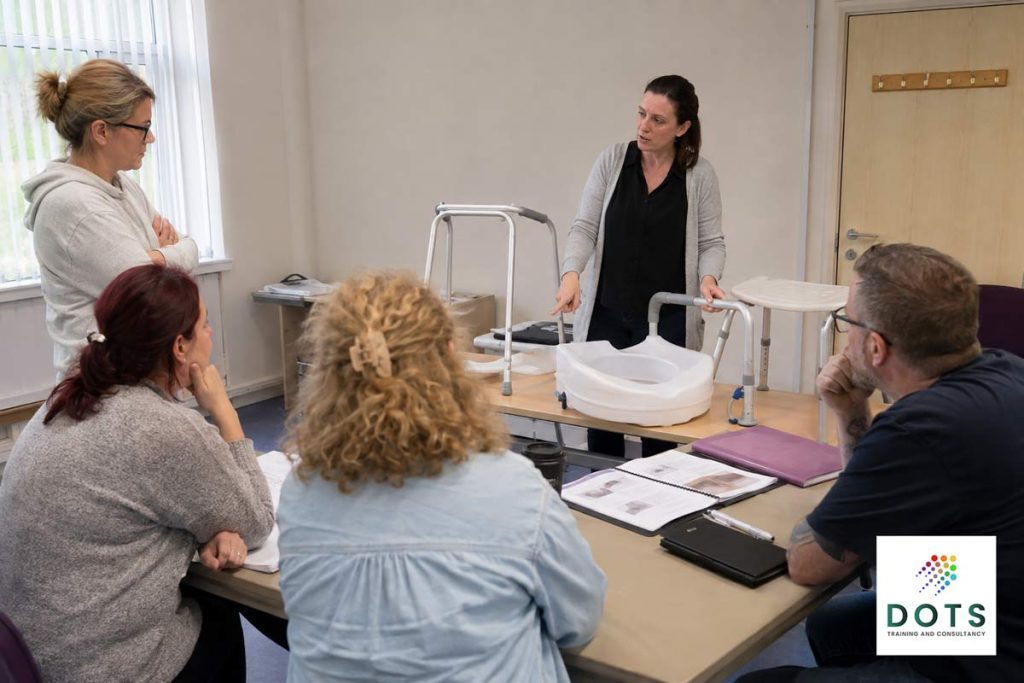
DOTS Training & Consultancy delivers OCN London accredited, OT-led Trusted Assessor training to organisations across the UK.
Our programmes are designed by experienced Occupational Therapists and are grounded in the realities of equipment provision, community assessment, risk and home environments.
We work with Local Authorities, NHS teams, housing providers and other organisations seeking to strengthen frontline capability while maintaining safe professional boundaries.
Level 2 Trusted Assessor Training
Our Level 2 Trusted Assessor Training establishes core assessment and safe prescribing skills for frontline staff working with simple equipment in straightforward cases.
The programme supports learners to develop a structured approach to assessment, equipment provision, risk awareness and escalation.
It is particularly relevant for organisations looking to build safe frontline assessment capacity within agreed local pathways.
Level 3 Trusted Assessor Training
Level 3 Trusted Assessor Training builds on core Trusted Assessor knowledge with greater emphasis on risk awareness, assessment reasoning and more developed decision making.
It supports staff taking greater responsibility within equipment provision and community assessment pathways.
Level 4 DFG Equipment and Adaptation Training
Our Level 4 DFG Equipment and Adaptation Training develops knowledge around home environments, adaptations and Disabled Facilities Grant related practice.
It is particularly relevant for staff involved in housing, access, bathing facilities and adaptation pathways where decisions extend beyond straightforward equipment provision.
Trusted Assessor Refresher Training
Competence needs to be maintained as well as developed.
Our Trusted Assessor Refresher Training helps existing Trusted Assessors revisit assessment principles, refresh knowledge and reinforce safe decision making.
For organisations preparing for increased autumn and winter demand, refresher training can provide an opportunity to strengthen consistency before pressure increases.
Trusted Technician Training
Safe equipment provision does not end when the assessment is completed.
Trusted Technician Training supports staff involved in practical equipment delivery, installation and safety checks.
This helps organisations strengthen the whole pathway from assessment through to appropriate installation and use.
Risk Assessment for Equipment Provision
Our Risk Assessment for Equipment Provision course explores risk, professional reasoning, escalation and defensible decision making in greater depth.
It supports learners to look beyond individual pieces of equipment and consider how function, environment, mental capacity, restrictive practice and risk interact.
This can be particularly valuable for organisations where staff need greater confidence managing situations that are not entirely straightforward.
Why this matters for commissioners and service managers
Trusted Assessor training should not be viewed simply as another training course.
When embedded within an appropriate service structure, it can support wider organisational objectives.
These include:
- strengthening frontline workforce capability
- reducing unnecessary referrals
- supporting faster responses to straightforward needs
- protecting specialist OT capacity
- improving consistency between assessors
- strengthening escalation pathways
- improving documentation
- supporting audit and quality assurance
- reducing inappropriate equipment provision
- improving outcomes for people using services
For commissioners and managers preparing for autumn and winter demand, this is fundamentally about having the right skills at the right level of the pathway.
Preparing now rather than reacting later
Workforce pressure is easier to manage when services prepare before demand reaches its highest point.
Trusted Assessors who understand their role, recognise risk and know when to escalate are better placed to respond confidently to straightforward needs.
Occupational Therapists can then focus their specialist expertise on the cases that genuinely require complex clinical reasoning.
The result is not simply faster equipment provision.
It is a more structured and proportionate approach to community assessment, where decisions are made at the right level, risks are recognised early and staff can explain and defend the reasoning behind their recommendations.
Ready to strengthen your team’s assessment capacity?
Whether you need to train new staff, refresh experienced assessors or strengthen an existing equipment provision pathway, DOTS Training & Consultancy can support your workforce development strategy.
Our nationally delivered Trusted Assessor programmes combine structured learning with practical Occupational Therapy experience to help staff make safer, more consistent and defensible decisions.
Explore our Trusted Assessor Training programmes or contact DOTS to request a tailored training proposal.
Frequently Asked Questions
A defensible decision is one where the assessor can demonstrate how and why a particular recommendation was reached. It should be based on the person’s needs, functional assessment, environmental factors, identified risks, available options and the assessor’s scope of practice. Clear documentation is an important part of making the reasoning transparent.
A Trusted Assessor is trained to assess certain straightforward needs and recommend agreed equipment or adaptations within defined organisational pathways. The exact scope of the role depends on the individual’s training, competence and local service arrangements.
Trusted Assessor training can help appropriately trained frontline staff manage straightforward cases safely while recognising when specialist Occupational Therapy assessment is needed. This can support more efficient pathways and allow OT capacity to be focused on complex or high risk work.
This depends on local policies and the scope of the Trusted Assessor role. Generally, a straightforward case would involve relatively stable needs, an intervention within the assessor’s agreed competence and no significant clinical, cognitive, safeguarding or environmental factors requiring specialist assessment.
Referral may be appropriate where needs are complex, risk is high, function is changing rapidly, there are repeated falls, significant cognitive concerns, complex transfers, moving and handling issues, safeguarding concerns, major adaptation requirements or uncertainty about the safest intervention.
Trusted Assessors may be involved in certain adaptation pathways depending on their level of training, competence and local service arrangements. More significant adaptations, complex housing needs and DFG related cases may require higher level training or specialist Occupational Therapy input.
The Mental Capacity Act requires professionals to assume capacity unless established otherwise, support people to make their own decisions and respect a person’s right to make decisions others may consider unwise. Where capacity concerns exist, staff should follow local procedures and remain within their professional role. Our Mental Capacity Act guide for Trusted Assessors explores this in more detail.
Good documentation shows what was assessed, what risks were considered, what options were discussed and why a particular decision was made. It supports continuity, professional accountability, audit and defensible practice.
Yes. Equipment may introduce additional risks if it is inappropriate, poorly positioned, incorrectly installed, not understood or not used as intended. Assessors should consider both the risk the equipment is intended to reduce and any new risks it could introduce.
This depends on the role your staff perform and the decisions they are expected to make. Level 2 supports core Trusted Assessor skills, Level 3 develops more advanced assessment and decision making, Level 4 focuses on DFG equipment and adaptations, while refresher, Trusted Technician and Risk Assessment courses support specific workforce needs.


Leave a Reply