
Occupational Therapy services across health, social care and housing are facing a difficult balancing act.
Demand for equipment, home adaptations and accessible housing continues to place significant pressure on community pathways. At the same time, Occupational Therapists are increasingly needed for complex work involving neurological conditions, rehabilitation, moving and handling, specialist equipment, major adaptations and situations where several clinical, environmental and social risks interact.
To protect the specialist contribution of Occupational Therapy, services need to address two challenges at the same time:
- Ensuring people with complex needs receive the specialist Occupational Therapy assessment and intervention they require.
- Reducing unnecessary delays for straightforward functional assessments, equipment and adaptations.
These goals are not in conflict.
Achieving both requires a proportionate approach to workforce design, with the right level of competence applied to the right level of need.
This is where well-designed, OT-led Trusted Assessor Training and clearly governed Trusted Assessor pathways can make a significant difference.
Matching competence to complexity
Not every equipment or adaptation request requires the same level of professional input.
Straightforward, relatively low-risk needs may be suitable for an appropriately trained Trusted Assessor working within a clearly defined organisational pathway.
As complexity and risk increase, so should the level of assessment skill, professional judgement and specialist input.
At the highest levels of complexity, qualified Occupational Therapy expertise becomes essential.
This principle is not new.
The Competence Framework for Trusted Assessors described equipment provision in terms of differing levels of need, risk, service volume and practitioner competence.
Later work around adaptations has reinforced the same underlying principle: the professional response should be based on the complexity of the person’s situation rather than simply the type or cost of the proposed solution.
For today’s services, that principle remains highly relevant.
The challenge is ensuring that workforce structures, training and escalation pathways reflect it.
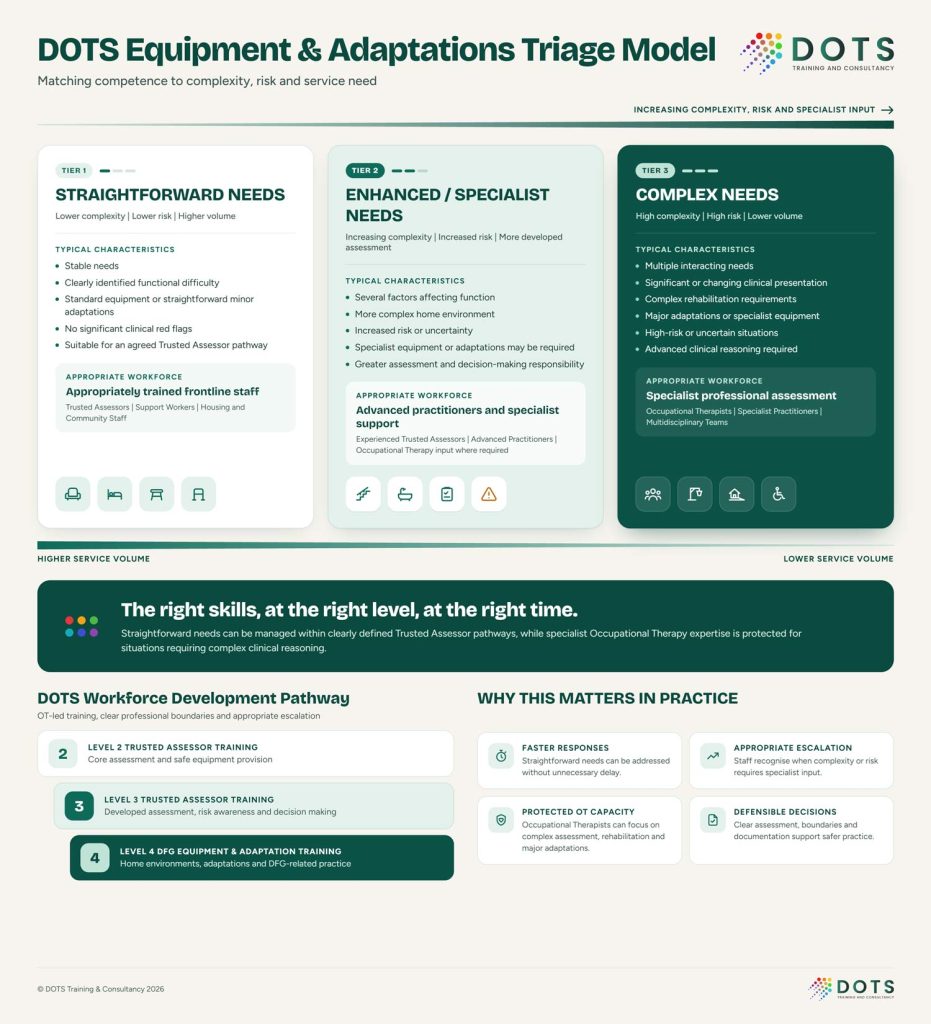
Matching competence to complexity can help straightforward needs receive a timely response while protecting specialist Occupational Therapy capacity for complex cases.
Where specialist Occupational Therapy expertise matters most
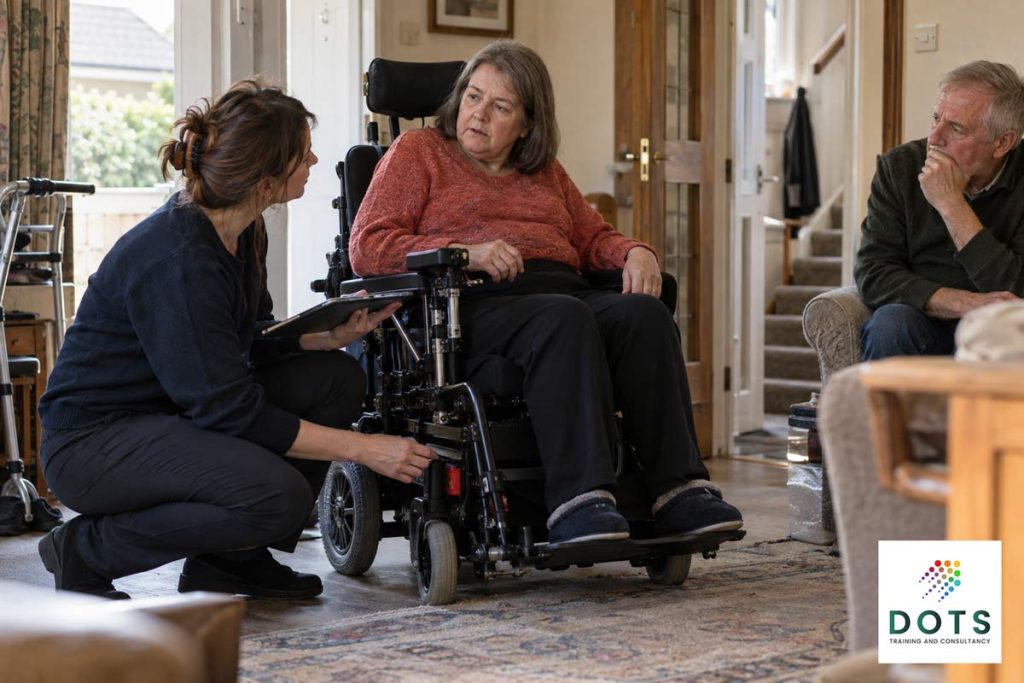
Occupational Therapy is at its most valuable where assessment requires complex clinical reasoning.
This may include people living with:
- progressive neurological conditions
- significant physical disability
- rapidly changing function
- complex seating or postural needs
- multiple interacting health conditions
- complex moving and handling requirements
- cognitive or perceptual difficulties
- significant rehabilitation potential
- complex mental capacity considerations
- high-risk home environments
- major housing adaptation needs
- complex family or carer circumstances
These situations cannot be reduced to selecting an item of equipment from a catalogue.
An Occupational Therapist may need to consider:
- physical function and biomechanics
- cognition and perception
- current and predicted future function
- rehabilitation potential
- moving and handling risk
- the interaction between the person and their environment
- capacity, consent and choice
- the impact of progressive conditions
- carer needs
- competing risks
- housing options
- long-term outcomes
The eventual solution may involve specialist equipment, rehabilitation, environmental redesign, a major adaptation, multidisciplinary intervention or a combination of these.
This is where specialist Occupational Therapy expertise has its greatest value.
The problem with using specialist capacity for every straightforward need
When every equipment or adaptation request follows the same pathway regardless of complexity, bottlenecks develop.
A person requiring a relatively straightforward grab rail may enter the same professional queue as someone with a progressive neurological condition requiring complex seating, transfers, access modifications and long-term housing planning.
That is not a proportionate use of specialist capacity.
If qualified Occupational Therapists spend substantial amounts of time completing assessments that could safely be undertaken by appropriately trained staff, less specialist capacity remains for people whose circumstances genuinely require Occupational Therapy.
The result can be delay at both ends of the pathway.
People with straightforward needs wait unnecessarily.
People with complex needs may also wait longer because specialist resources are occupied elsewhere.
Home adaptation delays have real consequences
Waiting for equipment or an adaptation is not simply an administrative inconvenience.
For the person waiting, it may affect their ability to:
- wash independently
- use the toilet safely
- enter and leave their home
- move between floors
- prepare food
- maintain personal care
- reduce reliance on family or carers
- remain safely at home
The English Housing Survey 2019 to 2020 found that approximately 1.9 million households in England included at least one person whose long-term health condition meant they required adaptations to their home.
Around one million of those households did not have all the adaptations they needed.
Approximately 374,000 households requiring adaptations considered their accommodation unsuitable for their needs.
Although these figures come from the 2019 to 2020 survey rather than current 2026 waiting-list data, they demonstrate the scale of unmet need that equipment and adaptation services are required to address.
Disabled Facilities Grant pathways and delay
Disabled Facilities Grants are an important route through which people can obtain adaptations that enable safer and more independent living.
However, delivery can involve several stages.
Foundations’ national analysis of DFG performance for 2023/24 reported an average:
- 114 working days from initial enquiry through the application stage
- 30 working days for approval
- 104 working days from approval to completion
- 247 working days across the complete pathway
That total had increased from 223 working days in the previous year.
Not every DFG case is straightforward. Major adaptations may require assessment, design work, consultation, permissions, contractors and significant building work.
However, these figures demonstrate why services need effective triage.
Straightforward needs should not automatically enter the same pathway as complex cases if they can be addressed safely at an earlier stage.
Why timely adaptations matter
Evidence also demonstrates that the timing of adaptations can affect outcomes.
The BATH-OUT-2 study explored what happened when older people experiencing bathing difficulties received adaptations more quickly rather than remaining within usual waiting pathways.
Reported outcomes included:
- substantially fewer falls
- improved independence
- an 8.7-point improvement on the Barthel Index
- greater independence with bathing
- reductions in health and social care costs
This is important because delay can have consequences beyond the original functional difficulty.
A person who becomes unable to bathe independently may begin relying on carers.
A person who loses confidence after a fall may reduce their activity.
Reduced activity can contribute to further loss of strength, mobility and independence.
Timely intervention can therefore support prevention as well as resolving the immediate problem.
Straightforward needs still require competent assessment
None of this means simple equipment should be issued without assessment.
A simple item does not necessarily mean a simple situation.
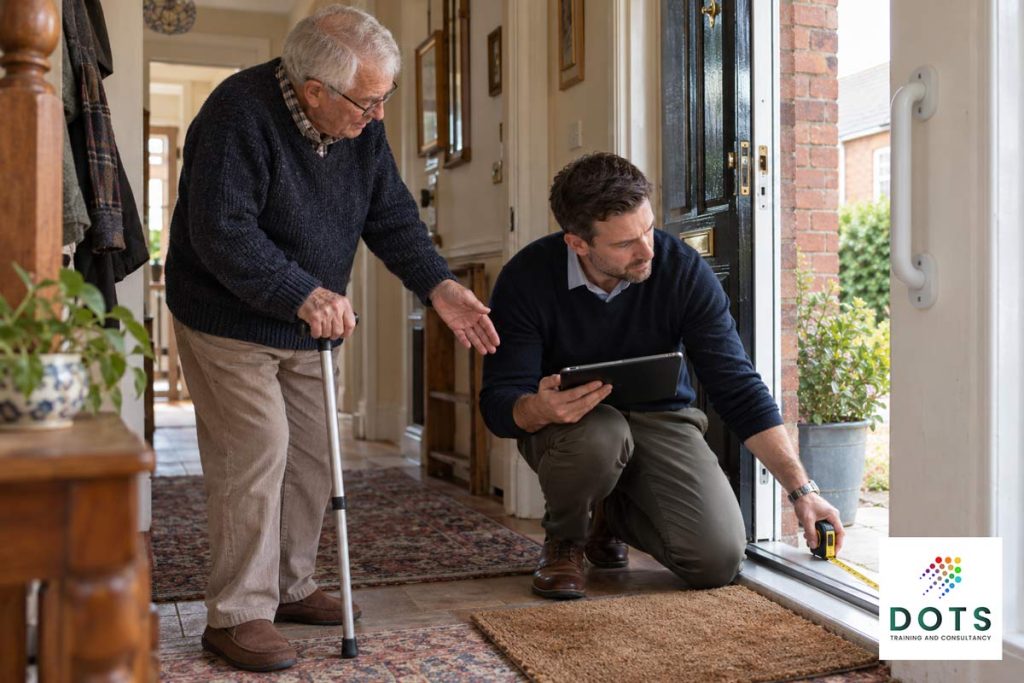
A grab rail may be entirely appropriate for one person and unsafe or ineffective for another.
A shower chair may appear to address a bathing problem, while the actual concern relates to transfers, cognition, balance or rapidly changing mobility.
The important distinction is therefore between straightforward needs and complex needs, not simply cheap equipment and expensive equipment.
An appropriately trained Trusted Assessor should understand:
- functional assessment
- the purpose and limitations of equipment
- environmental factors
- risk
- safe use
- consent
- professional boundaries
- when not to prescribe
- when to seek advice
- when to escalate to an Occupational Therapist
Recognising that a case has moved beyond the boundaries of a Trusted Assessor role is itself an important professional skill.
Our Risk Assessment for Equipment Provision training explores this area in greater depth, helping staff recognise risk, understand professional boundaries and make clear, defensible escalation decisions.
For further practical guidance, our article Preparing Frontline Teams for Autumn: Defensible Decisions in Equipment and Adaptations looks specifically at assessment reasoning, risk, escalation and defensible documentation in everyday equipment and adaptation practice.
Why DOTS places OT leadership at the centre of Trusted Assessor training
Streamlining straightforward assessments should not dilute Occupational Therapy expertise.
Done properly, it should protect it.
At DOTS Training & Consultancy, our Trusted Assessor Training programmes are designed and delivered by experienced Occupational Therapists.
We believe OT-led training provides an important clinical foundation for delegated assessment practice.
Occupational Therapists bring expertise in:
- functional assessment
- activity analysis
- environmental assessment
- risk and proportionality
- rehabilitation
- equipment and adaptations
- professional reasoning
- recognising complexity
- identifying when escalation is required
The purpose is not to turn Trusted Assessors into Occupational Therapists.
It is to ensure they understand the principles that support safe assessment, the boundaries of their role and the situations that require specialist input.
OT-led training is only one part of safe delegation
Training cannot operate in isolation.
Even excellent training needs to sit within appropriate organisational governance.
Safe Trusted Assessor pathways require:
- clearly defined roles
- agreed equipment and adaptation pathways
- local operating procedures
- clear limits of practice
- supervision and access to advice
- referral criteria
- safeguarding pathways
- consistent documentation
- competency review
- audit and quality assurance
- refresher training
A Trusted Assessor should know not only what they are competent to do, but also where that competence ends.
This protects the individual, the assessor and the organisation.
What OT-led Trusted Assessor training can achieve
A well-designed model has three important components.
1. Upskilling the wider workforce safely
Frontline staff can develop the competencies required to assess straightforward functional needs and recommend agreed equipment or adaptations.
Training should develop assessment skills rather than simply teaching people about products.
Learners need to understand:
- what the person is trying to achieve
- how function affects the activity
- how the environment influences risk
- whether equipment is genuinely required
- whether the proposed intervention is proportionate
- whether the situation falls within their scope
This creates competent assessors rather than equipment distributors.
2. Robust triage and referral pathways
An effective Trusted Assessor needs to know when not to proceed.
Clear escalation criteria should help staff identify:
- rapidly changing function
- repeated or unexplained falls
- complex transfers
- neurological deterioration
- complex moving and handling
- specialist seating needs
- significant cognitive concerns
- mental capacity issues requiring further assessment
- safeguarding concerns
- major environmental barriers
- uncertainty about the safest intervention
An effective Trusted Assessor does not eliminate referrals to Occupational Therapy.
They make better referrals because they understand why specialist assessment is required.
Where concerns relate specifically to a person’s ability to understand or make a decision, our guide to the Mental Capacity Act and Trusted Assessors explores how the five MCA principles apply to equipment and adaptation practice.
Frontline staff may also encounter situations involving restrictive practice. Our article on DoLS changes and frontline training considers why professional curiosity, recognition and appropriate escalation remain important as the legal landscape develops.
3. Protecting OT capacity for high-impact work
Appropriate delegation can allow qualified Occupational Therapists to focus their specialist skills on work such as:
- complex rehabilitation
- major adaptations
- specialist equipment
- neurological conditions
- complex housing solutions
- high-risk assessment
- multidisciplinary coordination
- rehabilitation planning
- service improvement
- preventative intervention
This is where the clinical reasoning of Occupational Therapists delivers greatest value.
Good triage is the key
Triage is the point at which the model either works or fails.
A service that directs every referral to an Occupational Therapist will struggle to release specialist capacity.
A service that moves people into Trusted Assessor pathways without appropriate safeguards risks missing complexity.
The answer is a proportionate system between those two extremes.
Good triage considers several questions.
What is the need?
What is the person actually struggling to do?
How complex is the situation?
Is there one clearly identified issue, or are several factors interacting?
What is the level of risk?
What might happen if the wrong decision is made?
Is the person’s situation stable?
Is the person’s function relatively predictable or changing?
What environmental factors are present?
Are there significant physical barriers within the home?
What competence is required?
Does the assessor have the appropriate knowledge, skills and authority?
Is escalation necessary?
Would the person’s needs be better addressed through specialist assessment?
This supports a response based on the person and their circumstances rather than simply the category of referral.
Accessible housing pressures reinforce the need for better pathways
The wider housing picture also demonstrates the need to use available professional resources effectively.
Habinteg research published in 2022 estimated that around 20,000 people were on English Local Authority waiting lists for a fully wheelchair-accessible home, with a further 104,000 people waiting for an accessible or adaptable property.
Based on building rates at the time of that research, Habinteg estimated that a wheelchair user joining a waiting list for a new wheelchair-accessible home could potentially wait up to 47 years.
These are 2022 research findings rather than current 2026 waiting-list totals, so they should be understood in that context.
Nevertheless, they demonstrate the long-standing pressure created by shortages of suitable housing.
Equipment, adaptations, housing advice and specialist Occupational Therapy all have important roles within that wider system.
Moving beyond professional territory
Discussions about delegation can sometimes become framed around professional territory.
Who should complete the assessment?
Who should prescribe the equipment?
Who owns a particular task?
A more useful question is:
What level of knowledge, competence and professional input does this person need in order to receive a safe and timely service?
For someone with complex neurological, functional and environmental needs, the answer may clearly be specialist Occupational Therapy.
For someone with a stable, straightforward requirement for standard equipment, an appropriately trained Trusted Assessor may be entirely suitable.
Matching competence to complexity does not diminish professional expertise.
It protects it.
Protecting Occupational Therapy does not mean protecting every task
There is understandable concern within professions about losing areas of practice.
However, requiring specialist clinicians to retain every activity historically associated with their profession can create unintended consequences.
If Occupational Therapists spend specialist clinical time carrying out work that can safely be completed by another appropriately trained member of the workforce, their availability for complex intervention is reduced.
Protecting Occupational Therapy should therefore mean protecting the expertise that defines it.
That includes:
- complex clinical reasoning
- activity analysis
- rehabilitation
- environmental problem solving
- complex adaptation
- specialist equipment
- managing interacting risks
- enabling meaningful participation and independence
That expertise should be available to the people who need it most.
A real-world example
Recently, I spoke with a housing provider that was waiting for Occupational Therapy assessments before relatively straightforward solutions could be approved for tenants.
Some of the items being considered were products that members of the public could purchase independently from retailers.
That does not mean professional assessment has no value.
It does raise an important question about proportionality.
Does every straightforward need require a full specialist Occupational Therapy pathway?
Or could appropriately trained staff safely assess and respond within an agreed framework, with clear access to OT support when circumstances become more complex?
For many organisations, addressing that question could reduce avoidable delay while protecting specialist capacity.
Building a workforce around levels of need
A useful service model can be thought of in broad levels of complexity.
Straightforward needs
These are relatively high-volume cases with lower levels of complexity and risk.
They may include standard equipment and straightforward minor adaptations where circumstances are stable and there are no significant clinical concerns.
Appropriately trained Trusted Assessors may be able to manage these cases within clearly defined organisational pathways.
Enhanced or specialist needs
These cases involve increased functional, environmental or clinical complexity.
They may require more developed assessment skills, specialist equipment, closer professional oversight or Occupational Therapy involvement.
Complex needs
These are generally lower-volume cases with high levels of complexity.
Examples may include:
- complex neurological conditions
- specialist seating
- complex transfers
- major adaptations
- rehabilitation
- significant cognitive issues
- several interacting risks
These cases require appropriately qualified specialist professional input.
The principle is simple:
As complexity and risk increase, the required level of competence and specialist input should increase with them.
The DOTS Trusted Assessor training pathway
Workforce roles differ between organisations.
A Local Authority equipment pathway may look very different from a housing provider’s adaptation service or an NHS community team.
Training therefore needs to reflect:
- the staff role
- the equipment or adaptations staff are expected to assess
- local policies
- the level of risk
- existing clinical support
- escalation routes
- the responsibility being delegated
DOTS therefore provides a structured Trusted Assessor Training pathway rather than treating Trusted Assessor competence as a single level.
Level 2 Trusted Assessor Training
Our Level 2 Trusted Assessor Training develops core assessment and safe equipment provision skills for staff working with straightforward needs.
The programme supports learners to develop a structured approach to:
- functional assessment
- equipment provision
- environmental considerations
- risk
- professional boundaries
- escalation
DOTS Level 2 Trusted Assessor Training is OCN London accredited.
Level 3 Trusted Assessor Training
Level 3 Trusted Assessor Training builds on core knowledge and develops more advanced assessment reasoning, risk awareness and decision making.
It supports practitioners taking greater responsibility within equipment provision and community assessment pathways.
DOTS Level 3 Trusted Assessor Training is OCN London accredited.
Level 4 DFG Equipment and Adaptation Training
Our Level 4 DFG Equipment and Adaptation Training develops knowledge of home environments, Disabled Facilities Grants, adaptations, risk and more advanced environmental assessment.
It is particularly relevant for staff involved in housing and adaptation pathways where decisions extend beyond straightforward equipment provision.
The DOTS Level 4 programme is currently progressing through OCN accreditation.
Trusted Assessor Refresher Training
Competence needs to be maintained as well as developed.
Our Trusted Assessor Refresher Training supports existing assessors to revisit key principles, update knowledge and reinforce safe, consistent practice.
Trusted Technician Training
Safe equipment provision does not end with the assessment.
Trusted Technician Training supports staff involved in practical equipment delivery, installation and checking, helping organisations strengthen the pathway from assessment through to safe use.
Risk Assessment for Equipment Provision
Our Risk Assessment for Equipment Provision course develops learners’ ability to consider risk proportionately and make clear, defensible decisions.
It explores the relationship between:
- function
- environment
- equipment
- independence
- mental capacity
- restrictive practice
- escalation
- documentation
The aim is not to eliminate all risk.
It is to enable staff to recognise risk, work within their competence and clearly justify their reasoning.
What this means for organisations
A well-designed Trusted Assessor model can create benefits across the pathway.
For people using services
It can support:
- faster responses to straightforward needs
- fewer unnecessary stages
- earlier support for independence
- more proportionate assessment
- clearer access to specialist help when required
For frontline staff
It can provide:
- clearer responsibilities
- greater confidence
- stronger assessment skills
- better escalation decisions
- defined boundaries of practice
For Occupational Therapists
It can create:
- more capacity for complex work
- fewer inappropriate referrals
- greater opportunity to apply specialist clinical reasoning
- more time for rehabilitation and complex intervention
For organisations
It can support:
- reduced bottlenecks
- clearer pathways
- better use of workforce capacity
- consistent decision making
- stronger documentation
- safer delegation
- improved audit and service assurance
The purpose is not simply to move work from one professional group to another.
It is to ensure the right skills are used at the right level, at the right time.
Protecting Occupational Therapy by using it where it matters most
The future of Occupational Therapy does not depend on qualified Occupational Therapists personally completing every straightforward equipment assessment.
It depends on recognising, valuing and protecting the specialist clinical reasoning that Occupational Therapists bring to complex situations.
Trusted Assessor pathways can support this when they are properly designed, clearly governed and underpinned by robust OT-led training.
Straightforward needs can be addressed sooner.
Complexity can be recognised and escalated earlier.
Occupational Therapists can focus more of their expertise where it has the greatest impact.
Most importantly, people receive a response proportionate to their needs rather than being required to follow the same pathway regardless of complexity.
For DOTS, that is the purpose of Trusted Assessor workforce development.
It is not about replacing specialist practice.
It is about building safe frontline capability while protecting specialist expertise for the people who need it most.
Strengthen your equipment and adaptation pathway
DOTS Training & Consultancy provides OT-led Trusted Assessor Training for Local Authorities, NHS organisations, housing providers and community services across the UK.
Our training pathway includes:
- Level 2 Trusted Assessor Training
- Level 3 Trusted Assessor Training
- Level 4 DFG Equipment and Adaptation Training
- Trusted Assessor Refresher Training
- Trusted Technician Training
- Risk Assessment for Equipment Provision
If your organisation is reviewing waiting lists, workforce capacity, equipment provision or the way adaptation referrals are triaged, DOTS can help identify the training needed to support a safer and more proportionate pathway.
Explore Trusted Assessor Training
Contact DOTS to discuss your workforce requirements
Frequently Asked Questions
No. A Trusted Assessor pathway enables appropriately trained staff to manage defined straightforward needs within their competence and local organisational procedures. Complex, high-risk or specialist situations should be referred to an Occupational Therapist or another appropriate specialist professional.
Trusted Assessors can help organisations respond more quickly to straightforward equipment and minor adaptation needs. When supported by appropriate training, governance and escalation pathways, this can reduce unnecessary specialist referrals and allow Occupational Therapy capacity to focus on complex work.
Occupational Therapists bring specialist knowledge of function, activity, risk, rehabilitation, equipment and the interaction between a person and their environment. OT-led training allows these principles to inform Trusted Assessor practice while reinforcing professional boundaries and appropriate escalation.
This depends on the individual’s competence and local organisational procedures. Trusted Assessor pathways typically focus on relatively stable, straightforward needs involving agreed equipment or adaptations where no significant clinical, environmental, cognitive or safeguarding concerns are present.
Referral may be appropriate where there is significant complexity, rapidly changing function, neurological deterioration, repeated falls, complex transfers, major adaptation requirements, specialist seating needs, moving and handling concerns, cognition or capacity issues, safeguarding concerns or uncertainty about the appropriate intervention.
Trusted Assessors can form part of a wider approach to reducing unnecessary delay. Appropriately trained staff can manage suitable straightforward cases rather than requiring every referral to enter the same specialist pathway.
The decision should be based on complexity, risk, competence, local governance and clearly defined escalation arrangements. The price or type of equipment alone should not determine the professional input required.
DOTS Level 2 and Level 3 Trusted Assessor Training programmes are OCN London accredited. The Level 4 DFG Equipment and Adaptation Training programme is currently progressing through OCN accreditation.
Alongside Level 2, Level 3 and Level 4 programmes, DOTS provides Trusted Assessor Refresher Training, Trusted Technician Training and Risk Assessment for Equipment Provision.
References and further reading
Assist UK. A Competence Framework for Trusted Assessors. Framework exploring relationships between service-user need, risk, service volume and practitioner competence.
Royal College of Occupational Therapists. Adaptations Without Delay. Guidance supporting proportionate approaches to home adaptation assessment and delivery.
Foundations. Performance of Housing Authorities in DFG Delivery. National data and analysis of Disabled Facilities Grant delivery times.
BATH-OUT-2 research programme. Research into the impact and cost effectiveness of expedited bathing adaptations for older adults.
Ministry of Housing, Communities and Local Government. English Housing Survey 2019 to 2020: Home Adaptations. Official statistics on adaptation needs and suitability of homes in England.
Habinteg Housing Association. Accessible housing research examining demand for wheelchair-accessible and adaptable homes in England.
NHS England. National Wheelchair Data Collection. National statistics covering wheelchair service users, referral to equipment delivery and service expenditure.


Leave a Reply